 VerSolveSystems Engineering
Replace or Integrate? When to Stop Paying for Your Business Software
The question every growing business hits
It usually starts at renewal time. The CRM went up again, the scheduling add-on now charges per user, and someone on your team spends Friday afternoons copying numbers from one system into another. The obvious reaction is to rip it all out and start fresh.
Sometimes that's the right call. More often it isn't. Replacing software is expensive, disruptive, and risky, and a business can spend a year migrating to a new platform only to land with the same problems in a new interface. The better question isn't "is this too expensive?" It's "what is this actually costing us, and what's the cheapest way to stop paying it?"
When integrating is the better answer
Connecting the tools you already have is usually faster, cheaper, and lower-risk. It's the right move when:
- The software does its core job well: your team likes the CRM; the problem is everything around it
- The pain is in the gaps: data typed into two or three places, reports built by hand, leads lost between systems
- Your team has real habits built on it: retraining everyone costs more than the subscription you'd save
- The vendor isn't going anywhere: the platform is stable, supported, and keeps improving
When replacing is worth it
Owning a system built for how you work starts to make sense when:
- You've outgrown it: the software was built for a smaller or different business, and your team works around it every day
- Costs climb with every hire: per-seat or per-location fees grow faster than the value you get
- You're stacking tools to cover gaps: three subscriptions that each half-solve the same problem
- It blocks how you want to operate: a workflow you need is impossible or locked behind an enterprise plan
- You don't control your own data: exporting it is hard, partial, or expensive
Decide with numbers, not frustration
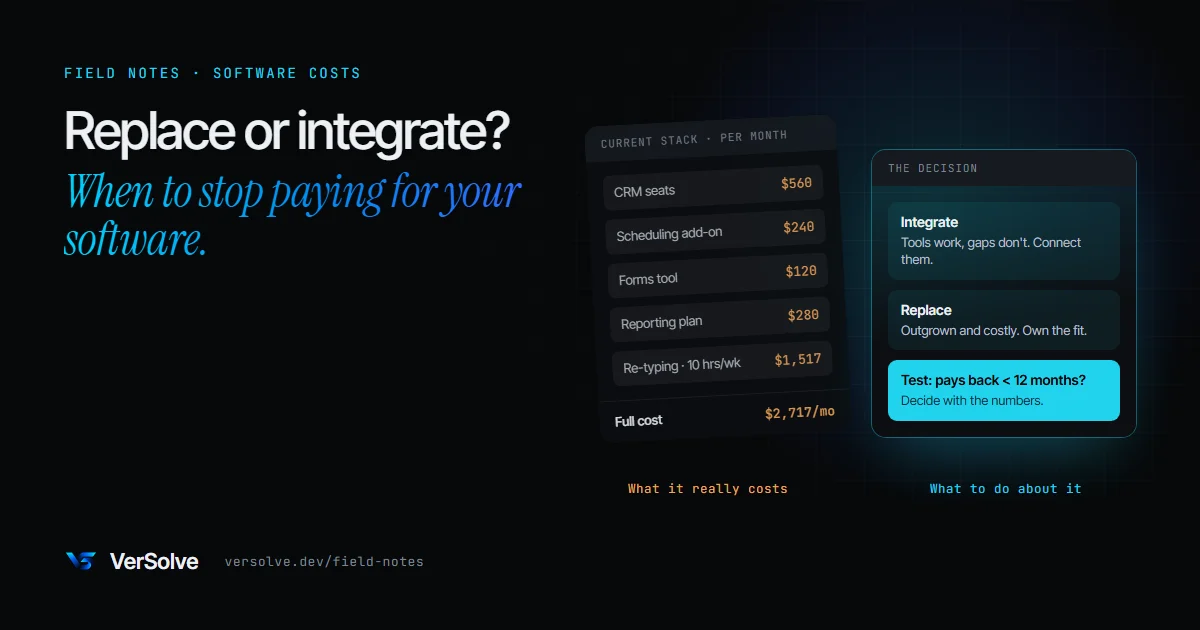
Frustration is a signal, not a business case. To decide, add up the full annual cost of the current setup: every subscription and add-on, the hours your team spends on workarounds and re-typing (multiplied by what those hours cost), and the cost of the errors and missed work that slip through the gaps.
Then compare that to the cost of the alternative. If an integration removes most of the pain for a fraction of the price, integrate. If a system you own would recover its cost within about a year and keep saving after that, replacing is worth a serious look. If neither passes that test, the honest answer may be to keep what you have and fix the process around it.
An illustrative example: a business paying $1,200 a month in overlapping subscriptions, plus ten hours a week of manual re-entry at $35 an hour, is carrying about $32,600 a year. A focused system that removes most of that cost could pay for itself within a year. One that only replaces the $1,200 subscription probably wouldn't.
The middle path: integrate first, replace in pieces
It rarely has to be all or nothing. Many businesses get the best result by connecting their existing tools first, which removes the re-typing and errors quickly, then replacing one piece at a time as the numbers justify it. Each step pays for the next, and nothing gets ripped out before its replacement is proven.
What to avoid
Whichever way you go, a few mistakes cost far more than the software ever did:
- Replacing because it's expensive: price alone isn't the problem; poor fit is
- Replacing everything at once: one big migration concentrates all the risk in a single cutover
- Building without owning: a custom system on someone else's accounts is just a different subscription
- Skipping the math: without a before-and-after number, you can't tell whether the change paid off
Not Sure Whether to Replace or Integrate?
Book a free 30-minute call with Luigi. We'll look at what your software stack is really costing you and whether integrating, replacing, or leaving it alone makes the most financial sense.